
Key Takeaways
- ✓Sleep paralysis affects roughly 8% of the general population and up to 28% of college students
- ✓It occurs when REM sleep muscle atonia persists into a conscious state
- ✓50% of people who experience sleep paralysis also report vivid hallucinations during episodes
- ✓Consistent sleep schedules and avoiding sleeping on your back are the two most effective preventive measures
Quick Answer: Sleep paralysis is a temporary inability to move or speak that occurs at the boundary between sleep and wakefulness. It happens when the muscle paralysis (atonia) that normally accompanies REM sleep leaks into conscious awareness. About 8% of the general population experiences it at least once, though rates climb to 28% among students and 40% among psychiatric patients. It is not dangerous, but it can be terrifying.
What is sleep paralysis?
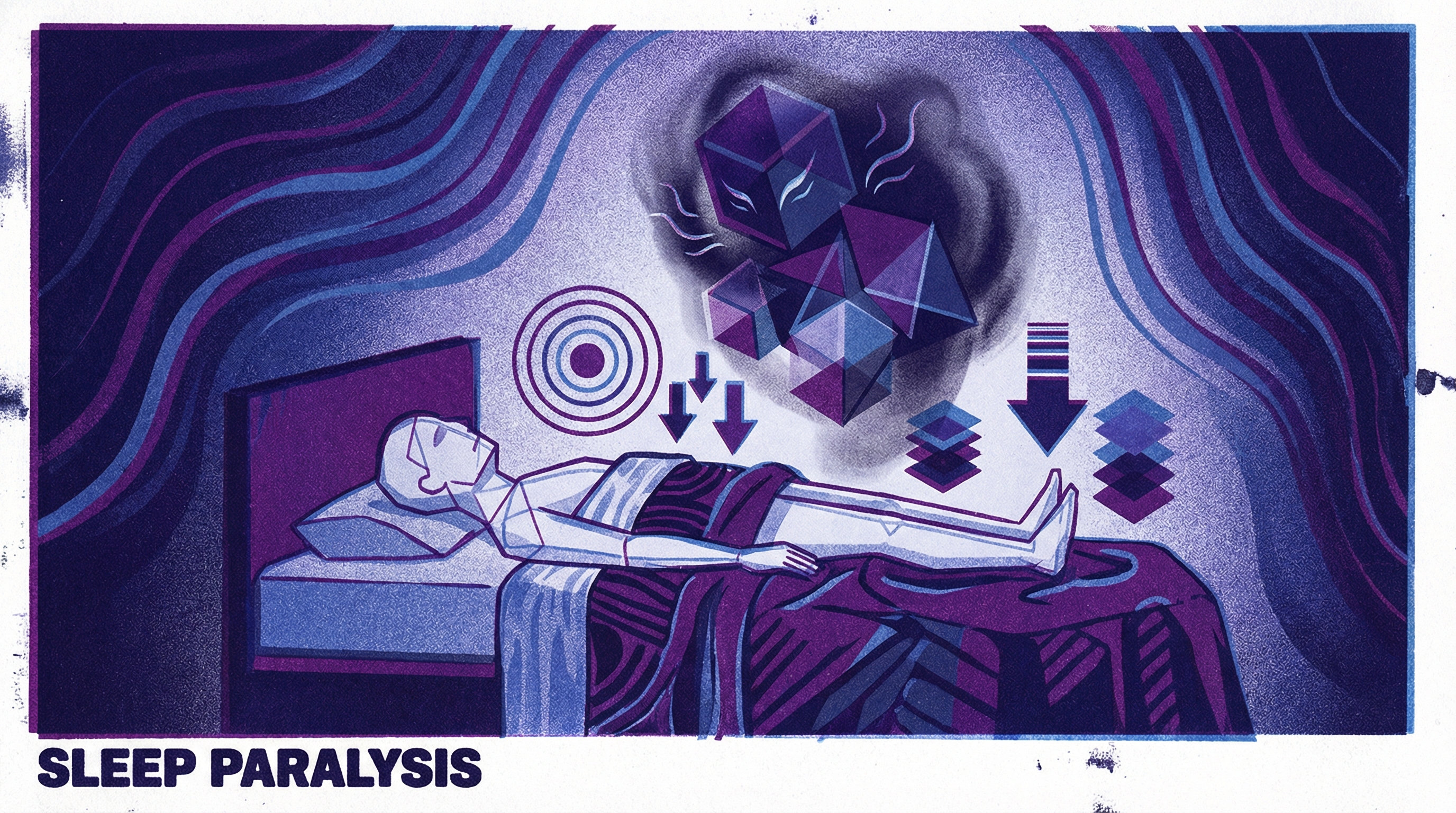
Sleep paralysis is a glitch in the transition between REM sleep and wakefulness. During REM sleep, your brain paralyzes your voluntary muscles to prevent you from acting out your dreams. This is called atonia, and it's a normal, protective mechanism. Sleep paralysis happens when you become conscious while that paralysis is still active.
The result: you're awake, you can see your room, but you can't move. You can't call out. You may feel pressure on your chest that makes breathing difficult. And because your brain is still partially in REM mode, you may hallucinate. Episodes typically last between a few seconds and two minutes, though they can feel much longer.
Sleep paralysis is classified as a parasomnia. It's not a disease, not a psychiatric condition, and not a sign that something is fundamentally wrong with your brain. It's a timing error in a system that usually transitions smoothly between sleep stages.
What causes sleep paralysis?
The immediate cause is always the same: REM atonia persisting into wakefulness. But several factors make this timing error more likely to happen.
| Risk Factor | How It Triggers Sleep Paralysis | Evidence Strength |
|---|---|---|
| Sleep deprivation | Causes REM rebound, which increases the chance of REM intruding into wakefulness | Strong |
| Irregular sleep schedule | Disrupts circadian rhythm, increasing REM-wake boundary errors | Strong |
| Sleeping on your back | Supine position associated with higher incidence in multiple studies | Moderate |
| Anxiety / chronic stress | Hyperarousal fragments sleep architecture, increasing REM disruptions | Strong |
| Narcolepsy | 30-50% of narcolepsy patients experience sleep paralysis as a core symptom | Strong |
| Genetics | Familial clustering suggests a heritable predisposition | Moderate |
The single most reliable trigger is sleep deprivation. When you don't get enough sleep, your brain compensates with "REM rebound," cramming in extra REM during whatever sleep you do get. More REM means more opportunities for the REM-wake boundary to malfunction.
Caffeine, alcohol, and certain medications (some antidepressants, ADHD drugs) also increase risk by disrupting normal sleep architecture. If you've recently changed medications and started experiencing sleep paralysis, that connection is worth discussing with your prescriber.
Why do people hallucinate during sleep paralysis?
Because your brain is still dreaming while you're conscious. About 50% of people who experience sleep paralysis also report vivid hallucinations during episodes. These aren't random. They fall into three well-documented categories:
- Intruder hallucinations: Sensing a threatening presence in the room. This is the most common and the most frightening. People report shadowy figures, someone standing in the doorway, or a presence sitting on their chest.
- Incubus hallucinations: Feeling pressure on the chest, difficulty breathing, or a choking sensation. This is likely caused by the REM atonia affecting respiratory muscles, which the brain then interprets as an external force.
- Vestibular-motor hallucinations: Feelings of floating, flying, or out-of-body experiences. These occur because the brain's movement-processing centers are active while the body is paralyzed, creating a disconnect.
"Sleep paralysis hallucinations are generated by the same neural mechanisms as dreams, but occur while the individual is conscious. The three hallucination categories (intruder, incubus, vestibular-motor) are consistent across cultures."
The cultural interpretation of these hallucinations varies enormously. The shadow figure has been described as a demon in Middle Eastern traditions, a ghost (kanashibari) in Japan, and the "Old Hag" in Newfoundland folklore. The experience is biologically identical; the narrative wrapper changes with culture.
Log sleep paralysis episodes the moment they end
DreamStream's voice recording captures the details of a sleep paralysis episode while the experience is still raw. Over time, AI analysis identifies your personal triggers: sleep deprivation patterns, stress correlations, and sleep position data.
Who is most likely to experience sleep paralysis?
Young adults, students, and people with anxiety disorders are at the highest risk.
- Age: Sleep paralysis typically begins in adolescence or early adulthood and peaks in the 20s and 30s. It tends to decrease with age.
- Students: 28-30% of university students report experiencing sleep paralysis, compared to about 8% of the general population. The combination of irregular sleep schedules, academic stress, and caffeine use creates a perfect storm.
- Psychiatric conditions: Up to 40% of psychiatric patients experience sleep paralysis. Panic disorder shows the strongest association (34.6% lifetime prevalence).
- Gender: Some studies report females experience sleep paralysis more frequently (up to 2.5x), though this finding isn't universal across all research.
If you're a stressed college student pulling irregular hours and drinking caffeine to compensate, you're essentially optimizing for sleep paralysis. That's not a criticism. It's just the biology.
How do I stop sleep paralysis?
Fix your sleep schedule. That's the single most effective intervention. Most of the evidence-based strategies boil down to improving sleep quality and reducing the conditions that trigger REM disruptions.
Practical steps that reduce sleep paralysis frequency:
- Consistent sleep schedule: Go to bed and wake up at the same time every day, including weekends. This is the single most impactful change. Your circadian rhythm needs consistency to properly sequence sleep stages.
- Get 7-9 hours of sleep: Sleep deprivation causes REM rebound, which is the primary trigger. Prioritize sleep quantity.
- Avoid sleeping on your back: Supine position is associated with more frequent episodes. Side sleeping reduces risk.
- Cut caffeine and alcohol 4-6 hours before bed: Both disrupt sleep architecture and increase the likelihood of REM-wake boundary errors.
- Manage stress: CBT, meditation, or any effective anxiety-reduction practice can reduce episodes. Stress-related hyperarousal fragments sleep.
- Treat underlying conditions: If you have insomnia, anxiety, PTSD, or narcolepsy, treating those conditions often resolves sleep paralysis as a secondary benefit.
What should I do during a sleep paralysis episode?
The most effective technique: stop fighting. The instinct is to struggle against the paralysis, but that intensifies the panic and can prolong the episode.
- Remind yourself it's temporary: Episodes almost always last under two minutes. Knowing this reduces panic.
- Focus on small movements: Try to wiggle your fingers or toes. Small voluntary movements can break the atonia faster than trying to force your whole body to move.
- Regulate your breathing: Slow, deliberate breathing can calm the panic response and counteract the sensation of chest pressure.
- Don't engage with hallucinations: If you see or sense something, remind yourself it's a dream artifact. The hallucination is generated by REM-stage neural activity, not reality.
Some people find that rapid eye movements can help trigger the end of an episode, since eye muscles are the only voluntary muscles not fully paralyzed during REM atonia.
When should I see a doctor about sleep paralysis?
Occasional sleep paralysis doesn't require medical intervention. But there are clear thresholds where professional help becomes appropriate:
- Frequent episodes: If sleep paralysis happens multiple times per week, a sleep specialist can evaluate whether an underlying sleep disorder (particularly narcolepsy) is involved.
- Excessive daytime sleepiness: If you're consistently sleepy during the day alongside sleep paralysis, narcolepsy screening is warranted.
- Sleep avoidance: If the fear of sleep paralysis is causing you to avoid sleep or significantly delay bedtime, the secondary effects (sleep deprivation, anxiety) become a clinical concern.
- Co-occurring hallucinations while awake: Hallucinations exclusively during sleep paralysis are normal. Hallucinations at other times are not and warrant evaluation.
Track sleep paralysis episodes and find your triggers
DreamStream's Dream Radar tracks all sleep events, including paralysis episodes. Over time, it maps correlations with your sleep schedule, stress levels, and sleeping position, helping you identify and eliminate your personal triggers.
The bottom line
Sleep paralysis is a REM sleep timing error, not a medical emergency. It's common, it's well-understood, and it responds to straightforward interventions: consistent sleep schedule, adequate sleep duration, side sleeping, and stress management. The hallucinations are the brain dreaming while conscious. Knowing the mechanism robs it of most of its power. For more on how REM disruption affects dream intensity, see our guide on what causes vivid dreams.