
Key Takeaways
- ✓Why Are Nightmares Becoming More Common?
- ✓What Is IRT?
- ✓The 3-Phase Process
- ✓Does IRT Actually Work?
Quick Answer: Imagery Rehearsal Therapy (IRT) is a nightmare rescripting technique where you write a safer version of a recurring nightmare and rehearse it while awake. Research supports IRT for some recurring and trauma-related nightmares, but frequent or severe nightmares should be discussed with a qualified clinician.
Why Are Nightmares Becoming More Common?
Nightmares can become more frequent during periods of stress, trauma exposure, disrupted sleep, medication changes, or irregular schedules. The American Academy of Sleep Medicine position paper discusses both psychological and pharmacological options for nightmare disorder in adults.
Occasional bad dreams are common. The concern is a repeated pattern: nightmares that make you avoid sleep, wake in distress, or feel impaired the next day. Trauma-related nightmares need particular care because the dream can keep replaying a threat memory rather than resolving it.
Medication may be appropriate for some people, and psychological approaches may be appropriate for others. The best path depends on the cause, frequency, distress level, medical history, and whether trauma or another sleep condition is involved.
What Is Imagery Rehearsal Therapy (IRT)?
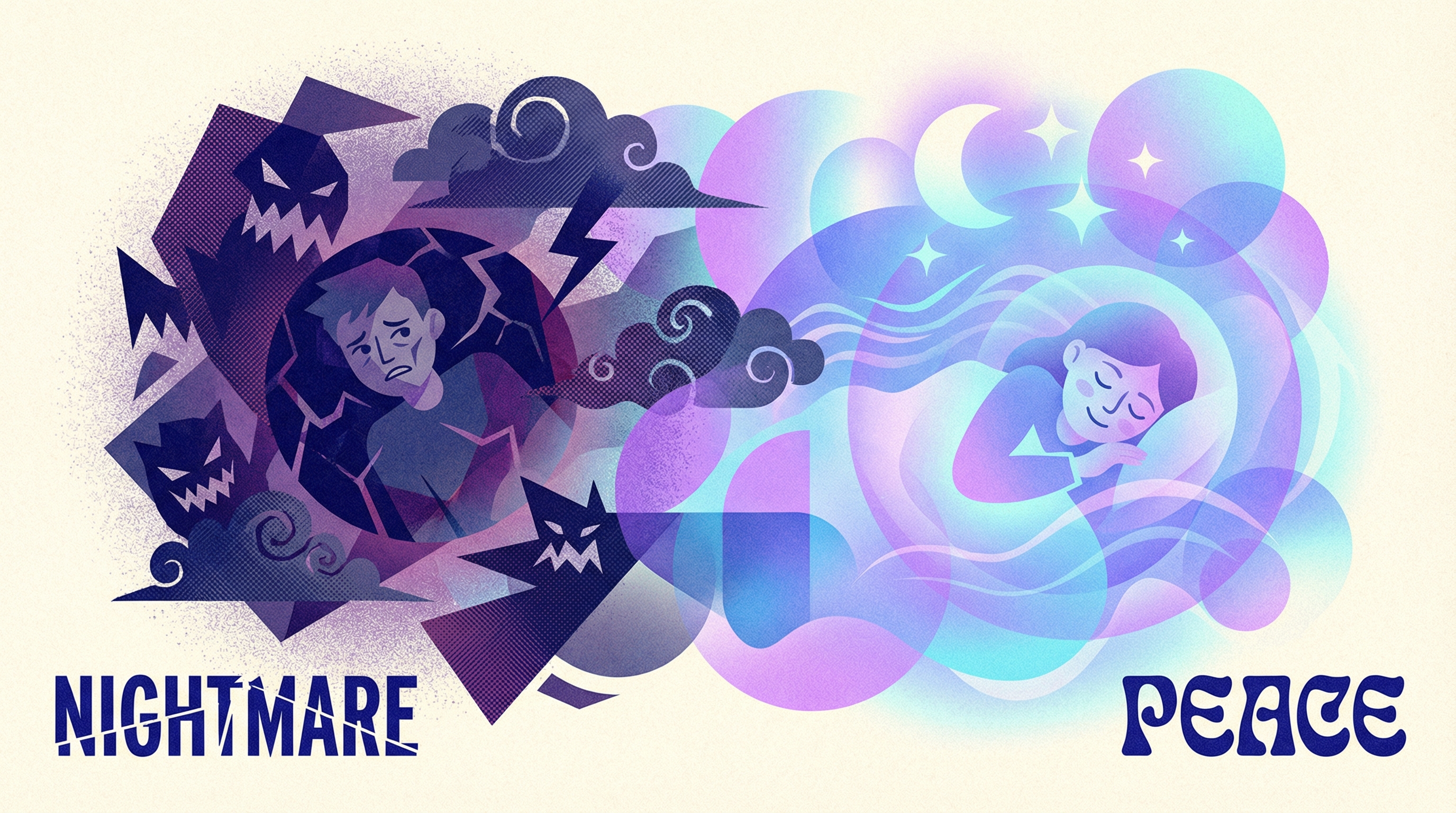
IRT is a structured, drug-free technique where you consciously rewrite a nightmare and rehearse the new version while awake. The goal is not to deny the original dream. The goal is to give the brain a safer path to practice.
The theory is elegantly simple: nightmares are "stuck" narratives. Your brain replays traumatic or frightening scenarios because it hasn't found resolution. IRT breaks this loop by giving you agency over the dream's conclusion.
The 3-Phase IRT Process
Confront
Recall the nightmare in detail. Identify the core "trigger".
Rescript
Consciously rewrite the ending. You control the outcome.
Rehearse
Visualize the new ending daily. Practice visualization.
The three-phase Imagery Rehearsal Therapy protocol
Therapist-led IRT can be valuable, especially when nightmares are trauma-linked or severe. A guided app can support the low-risk parts of the practice: recording the nightmare, drafting a revised ending, rehearsing it, and tracking whether distress changes over time.
Does IRT Actually Work?
Research supports IRT as one option for reducing nightmare frequency and distress, especially when nightmares repeat. It is not a universal cure, and the evidence is stronger for structured IRT than for generic "positive thinking" or untested app flows.
"Nightmare disorder guidance discusses imagery rehearsal therapy as a psychological treatment option, alongside medication options that require medical supervision."
A comparative meta-analysis found both prazosin and IRT were associated with improvements in nightmare frequency, sleep quality, and PTSD symptoms. That does not mean one replaces the other; it means both belong in the evidence conversation.
Comparative Study Results
| Approach | What research suggests | Important caveat | Best role |
|---|---|---|---|
| Prazosin (medication) | Can reduce PTSD-related nightmares for some patients | Requires prescriber guidance and side-effect monitoring | Medical option for appropriate patients |
| Traditional IRT | Moderate evidence for reducing nightmare frequency and distress | Works best when practiced consistently and adapted to the person | Therapist-led or guided self-help technique |
| AI-guided journaling | Can structure prompts, rescripting, reminders, and reflection | Not a clinical substitute and not independently proven as IRT | Support tool alongside journaling or care |
| Sleep Hygiene Alone | Can reduce triggers like sleep loss and fragmented REM | May be insufficient for chronic, trauma-linked nightmares | Baseline support for better sleep stability |
What the Evidence Supports
Categorical summary, not a quantitative ranking
Illustrative summary only: these categories are not percentages or effect sizes. Evidence varies by population, diagnosis, and treatment plan.
Requires clinician supervision and side-effect monitoring.
Best fit for recurrent nightmares when practiced consistently.
Useful for prompts and structure, not clinical proof of treatment.
How Can AI Support Nightmare Rescripting?
AI can support the three-phase IRT workflow by helping you structure the nightmare, brainstorm a calmer ending, and remember to rehearse the new version. That is support for journaling and reflection. It is not the same as receiving therapy from a licensed clinician.
Here's how it works in practice. When you log a nightmare in an AI dream journal app like DreamStream, the AI can help organize the narrative structure, emotional content, and distressing elements. It then suggests a personalized rescripted ending that:
- Maintains plausibility: The new ending feels believable, not fantastical.
- Empowers the dreamer: You gain control or resolution.
- Reduces emotional charge: The new narrative is calming, not activating.
You can edit this AI-generated ending or request regeneration until it resonates. Once saved, the app provides rehearsal tools: text-to-speech so you can listen to the ending before bed, and optionally, a "healing image" (a visual representation of the new ending) generated by AI to act as a mental anchor.
The useful part is friction reduction. If an app helps you write the nightmare down, choose a believable safer ending, and practice consistently, it can support the behavior IRT depends on. It should also tell you when the situation is outside self-guided support.
AI-Guided Nightmare Healing with IRT Protocol
DreamStream guides you through a 3-Phase nightmare rescripting flow (Confront, Rescript, Rehearse) with optional text-to-speech rehearsal. Not a substitute for professional care.

How Does IRT Compare With Nightmare Medications?
IRT and medication are different tools. IRT changes the dream script through rehearsal. Medication, when prescribed, changes physiological pathways that may contribute to nightmares or sleep disruption. Neither should be framed as a universal replacement for the other.
Prazosin is an alpha-1 blocker originally used for blood pressure. Some clinicians prescribe it for PTSD-related nightmares, but it can cause dizziness, blood pressure changes, or other side effects and needs medical oversight.
IRT is a skills-based intervention. Once you learn the rescripting technique, you can keep practicing it. That makes it attractive for people who want a non-drug option or a complement to clinical care.
That said, some patients benefit from combination therapy: prazosin for acute symptom relief while learning IRT, then tapering the medication as psychological skills strengthen. Always consult your provider before changing prescriptions.
When Might I Notice a Change?
Some people notice less distress after a few weeks of consistent rehearsal; others need clinician support, a different approach, or treatment for an underlying sleep or mental health condition. Consistency matters, but so does knowing when self-guided work is not enough.
Think of IRT like physical therapy for your brain. You wouldn't expect one PT session to heal a torn ligament; you'd do prescribed exercises daily. The same applies here. The recommended protocol:
- Week 1-2: Rescript your worst nightmare. Rehearse the new ending for 20 minutes before bed, every night.
- Week 3-4: Notice decreased distress when you recall the nightmare. Sleep quality may improve.
- Week 5-6: Nightmare frequency drops. You may notice that when the nightmare does occur, it sometimes follows the rescripted ending.
If nightmares are getting more intense, are tied to trauma, or make you afraid to sleep, do not wait months to get help. Self-guided rescripting can be useful, but it should not delay appropriate care.
📅Mental Recovery Timeline
Week 1-2: Narrative Shift
Rescript nightmare endings. Daily rehearsal (20 mins) builds initial agency.
Week 3-4: Emotional Buffering
Reduced distress upon waking. Subconscious brain begins prioritizing new scripts.
Week 5-6: Narrative Dominance
Frequency drops. Nightmares follow rescripted endings or dissolve entirely.
A private dream journal app like DreamStream can help you track nightmare frequency, rehearsal consistency, and distress over time. That record can also make conversations with a clinician more concrete.
The Bottom Line
Nightmares can improve, but the right help depends on the pattern. IRT gives many people a practical way to rewrite and rehearse a safer ending. AI-guided journaling can make that practice easier to start. For frequent, trauma-linked, or daytime-disrupting nightmares, bring the pattern to a qualified professional.