
Key Takeaways
- ✓IRT achieves 46% success rates, matching prazosin medication without side effects
- ✓AI automation makes therapy-grade nightmare treatment accessible 24/7
- ✓Most users see reduced nightmare distress within 2-3 weeks
- ✓Traditional IRT costs $1,200-2,400 vs $0-50/month for AI-automated tools
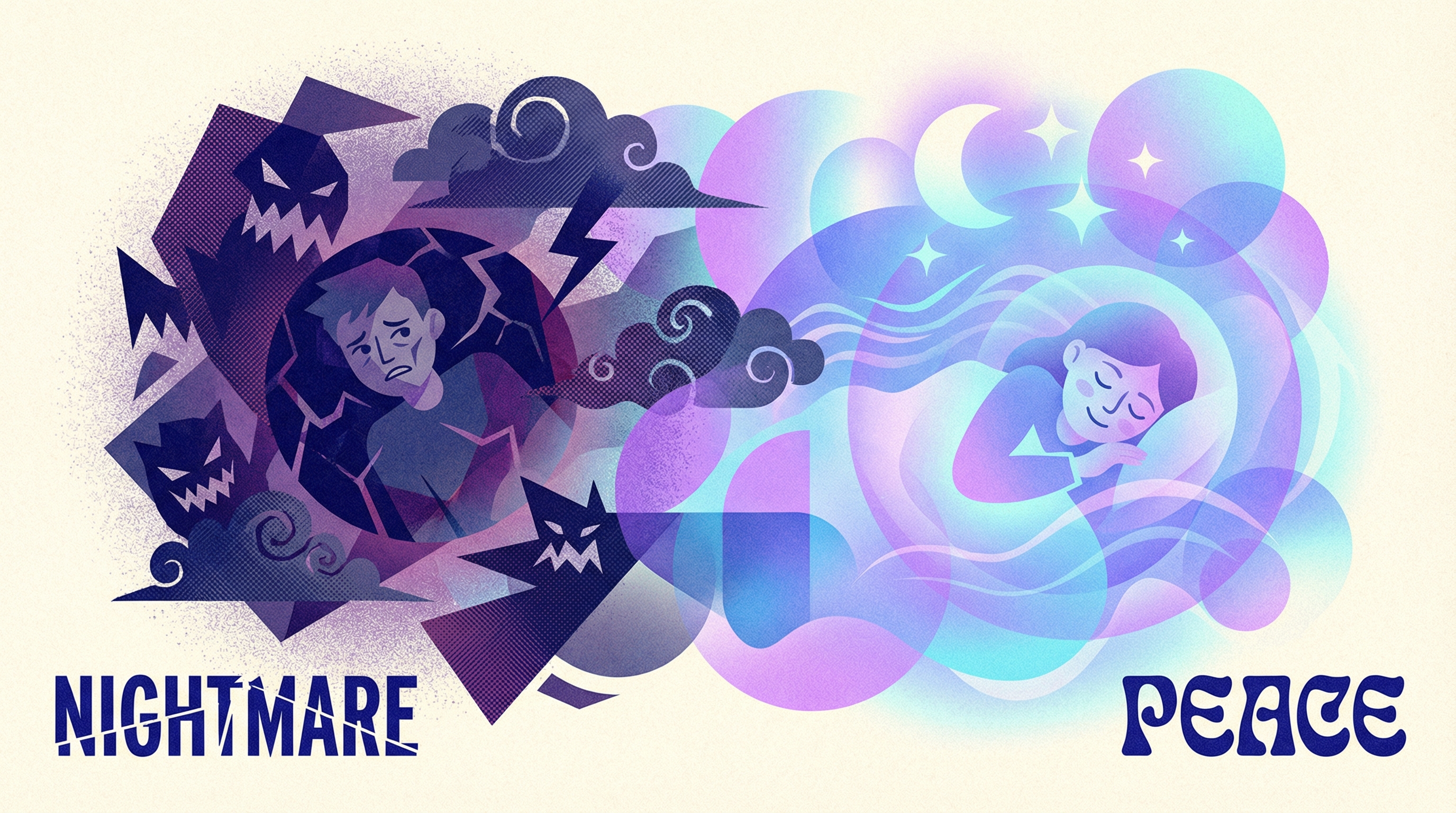
Quick Answer: Imagery Rehearsal Therapy (IRT), now automated by AI, matches the 46% success rate of prescription medications like prazosin, without side effects. This evidence-based treatment helps you rewrite nightmare endings and rehearse new narratives, with most people experiencing relief within 2-3 weeks.
Why Are Nightmares Becoming More Common?
PTSD diagnoses increased 25% post-pandemic, and chronic stress from 2020-2025 created a "perfect storm" for nightmare disorders. According to the American Academy of Sleep Medicine, nightmare disorder diagnoses have surged, with many patients seeking non-pharmacological treatments.
The situation has changed. We went from occasional "bad dreams" to chronic, distressing nightmares that fragment sleep architecture. Pandemic-era trauma, economic uncertainty, and social isolation created unprecedented levels of sustained stress. For context, PTSD-related nightmares affect up to 80% of trauma survivors, but even those without diagnosed PTSD are experiencing heightened nightmare frequency.
Doctors traditionally prescribed medication, primarily prazosin, an alpha-blocker originally designed for hypertension. But there's a growing movement toward evidence-based psychological interventions that offer durable relief without pharmacological dependency.
What Is Imagery Rehearsal Therapy (IRT)?
IRT is a clinically-proven, drug-free technique where you consciously rewrite nightmare endings, reducing frequency by 46% in studies. First developed in the 1990s, IRT has become the gold-standard psychological treatment for chronic nightmares.
The theory is elegantly simple: nightmares are "stuck" narratives. Your brain replays traumatic or frightening scenarios because it hasn't found resolution. IRT breaks this loop by giving you agency over the dream's conclusion.
The 3-Phase IRT Process
Confront
Recall the nightmare in detail. Identify the core "trigger".
Rescript
Consciously rewrite the ending. You control the outcome.
Rehearse
Visualize the new ending daily. Practice visualization.
The three-phase Imagery Rehearsal Therapy protocol
Traditional IRT requires 6-8 sessions with a trained therapist, costing $1,200-2,400. This is where AI automation becomes transformative. Apps like DreamStream guide users through the entire protocol: generating personalized rescripted endings, providing rehearsal tools like text-to-speech, and even creating visual anchors (healing images) to strengthen the new narrative.
Does IRT Actually Work?
Yes. A 2020 meta-analysis comparing prazosin and IRT found both reduced nightmares by 40-46%, with IRT offering superior long-term durability. The research is compelling.
"Imagery rehearsal therapy is recommended as the first-line treatment for PTSD-associated nightmares, with effect sizes comparable to pharmacological interventions but without adverse effects."
A systematic review and meta-analysis analyzed six randomized controlled trials and concluded that IRT significantly reduces nightmare frequency and distress. Crucially, the benefits persist after treatment ends, unlike medication, which often requires indefinite use.
Comparative Study Results
| Treatment | Success Rate | Side Effects | Cost |
|---|---|---|---|
| Prazosin (medication) | 40-46% | Hypotension, dizziness | $30-60/mo |
| Traditional IRT | 46% | None | $1,200+ |
| AI-Automated IRT | ~46% (emerging data) | None | $0-50/month |
| Sleep Hygiene Alone | 10-15% | None | Free |
Clinical Success Rates
Comparative Efficacy: Meta-Analysis 2020
How Does AI Make IRT Accessible?
AI automates the three-phase IRT protocol (Confront, Rescript, Rehearse), making therapy-grade nightmare treatment available 24/7 without waiting lists or high costs. The AI in mental health market reached $1.80 billion in 2025, with nightmare therapy apps becoming a validated use case.
Here's how it works in practice. When you log a nightmare in an app like DreamStream, the AI analyzes the narrative structure, emotional content, and distressing elements. It then generates a personalized rescripted ending that:
- Maintains plausibility: The new ending feels believable, not fantastical.
- Empowers the dreamer: You gain control or resolution.
- Reduces emotional charge: The new narrative is calming, not activating.
You can edit this AI-generated ending or request regeneration until it resonates. Once saved, the app provides rehearsal tools: text-to-speech so you can listen to the ending before bed, and optionally, a "healing image" (a visual representation of the new ending) generated by AI to act as a mental anchor.
The democratization here is profound. Traditional IRT requires finding a therapist trained in the protocol (rare), scheduling 8 weekly sessions, and paying out-of-pocket if insurance doesn't cover it. AI makes the same evidence-based protocol available instantly, globally, and at a fraction of the cost.
AI-Guided Nightmare Healing with IRT Protocol
DreamStream guides you through a 3-Phase nightmare rescripting flow (Confront, Rescript, Rehearse) with optional text-to-speech rehearsal. Not a substitute for professional care.
Can IRT Replace Nightmare Medications?
For many patients, yes. While prazosin works, it causes hypotension in 15-20% of users. IRT has zero side effects and stronger evidence for sustained relief. The choice isn't always binary, but IRT should be the first-line treatment.
Prazosin, the most prescribed nightmare medication, was originally a blood pressure drug. It works by blocking adrenaline receptors, which dampens the physiological arousal that fuels nightmares. The problem? Orthostatic hypotension (dizziness upon standing), daytime drowsiness, and the need for indefinite use. According to a scoping review in Neuropsychiatric Investigation, up to 20% of patients discontinue prazosin due to side effects.
IRT, however, is a skills-based intervention. Once you learn the rescripting technique, it's yours. A follow-up study found that 70% of IRT responders maintained benefits at 6-month follow-up, even after stopping active practice.
That said, some patients benefit from combination therapy: prazosin for acute symptom relief while learning IRT, then tapering the medication as psychological skills strengthen. Always consult your provider before changing prescriptions.
How Long Until I See Results?
Most users report reduced nightmare distress within 2-3 weeks. Full efficacy typically appears after 4-6 weeks of daily rehearsal. Consistency is key.
Think of IRT like physical therapy for your brain. You wouldn't expect one PT session to heal a torn ligament; you'd do prescribed exercises daily. The same applies here. The recommended protocol:
- Week 1-2: Rescript your worst nightmare. Rehearse the new ending for 20 minutes before bed, every night.
- Week 3-4: Notice decreased distress when you recall the nightmare. Sleep quality may improve.
- Week 5-6: Nightmare frequency drops. You may notice that when the nightmare does occur, it sometimes follows the rescripted ending.
A pilot study on Nightmare Deconstruction and Reprocessing (NDR), a variation of IRT, showed medium effect sizes for decreasing nightmares and insomnia within 4 weeks. The takeaway: early intervention matters. Don't wait months of suffering before trying IRT.
📅Mental Recovery Timeline
Week 1-2: Narrative Shift
Rescript nightmare endings. Daily rehearsal (20 mins) builds initial agency.
Week 3-4: Emotional Buffering
Reduced distress upon waking. Subconscious brain begins prioritizing new scripts.
Week 5-6: Narrative Dominance
Frequency drops. Nightmares follow rescripted endings or dissolve entirely.
Apps like DreamStream track your progress, sending reminders to rehearse and measuring nightmare frequency over time. This data-driven approach helps you stay consistent and provides tangible proof of improvement.
The Bottom Line
Nightmare disorder is treatable. IRT offers a proven, side-effect-free alternative to medication, and AI has made it accessible to everyone with a smartphone. If you've been suffering through nights of terror, hoping it will pass, it won't without intervention. Start with IRT. Give your brain the new narrative it's been searching for.